A sustainable local chapter is a community of volunteers guided by four core principles, which we define as the 4Ps: Purpose, People, Programs, and Planning. Alongside these, we need enablers that allow volunteers to gain awareness, autonomy, and competence: Staff Support, Training, and Funds.

The goal of the chapter is to create the largest possible volunteer base, allowing all tasks to be equally distributed among volunteers based on their potential, availability, and passions. From the staff’s perspective, the goal is to support each chapter in gaining autonomy through ongoing training and support, so that volunteers are empowered to reach their full potential.

Once a chapter gains autonomy, the goal is also to start working with longer-term perspectives, increasing the impact in the community, and expanding the AFS mission.


Purpose

Every chapter should have a clear purpose that motivates its volunteers by connecting their daily efforts to the bigger picture of AFS: developing more active global citizens
uploads_4000099_4001636436_processed_r-5XMTQa8IUCU225JOPX54ZzrUOHjQ5irq02P2XhBE

Thriving Together: How Purpose and Ethics Drive Innovation

Purpose is closely linked to the Engagement Step of the Volunteer Journey: AFS volunteers join motivated by various reasons. Purpose (the why) also connects with ethics (the how) and innovation. A clear sense of purpose, rooted in AFS values, guides ethical action and inspires meaningful, sustainable innovation. 

Purpose-driven innovation improves decision-making and creates lasting impact. For a chapter to evolve and respond to societal changes, openness to new ideas is vital. Cultivating ethical group dynamics, with a focus on open communication, psychological safety, and inclusivity, supports a strong organizational culture. Respectful communication, transparency, and collaboration lead to better problem-solving and an effective implementation of new ideas. 

Questions for Analysis

Use these questions to guide reflection on the chapter's Purpose:

✦ Why does the chapter exist?

✦ What do we want to achieve as a team?

✦ What motivates us to keep going as volunteers?

✦ Which impact do we generate in our community?

✦ How diverse is our group?

✦ What do we do to encourage diversity and inclusion within our group?

✦ How do we approach change?

✦ Are we considering different perspectives when facing a decision-making process?

People

Our goal for local chapters is to have strong and diverse local groups with motivated volunteers who feel seen and valued.

Human Capital is at the base of Volunteerism

The knowledge, skills, energy, and values that individuals bring are the foundation of any successful volunteer effort. But, to have a sustainable chapter, individuals are not enough: we must create a group.
When many volunteers come together, their combined human capital becomes something greater. It’s not just about people doing tasks: it’s about a team growing, learning, and leading together.

How many volunteers make up a Chapter? The minimum suggested number is 3 to 5. We don’t just need people to build a chapter; we need a group that works well together, with good team spirit among members. The more people are part of the team, the more results the chapter can aim to achieve.

Questions for Analysis

Think about the people who shape your chapters:

✦ How many volunteers make up a chapter in my organization?

✦ How does a chapter look like in terms of human capital?

✦ How do we support group dynamics?

✦ How do we train and support leadership development?

✦ How do we support and encourage diversity within our chapter?

✦ How do we recognize and appreciate local volunteers?

Programs

Programs are the core of our action at the local level. Our goal is to strengthen the local ability to support participants, families, and schools, making every experience the best possible.

Programs as our core

Hosting, Sending, Educators and School Relations, both in person and online, are the operations that keep our local chapters alive. Ideally, every area should have a subteam of volunteers contributing to it.
Each of these processes varies from Partner to Partner: this is why clarity in processes brings clarity in volunteer training and the ability to impact at the local level.

To ensure a well-functioning chapter, it’s essential to clearly define responsibilities, assign roles, and regularly evaluate how well everything is working. Roles should not be permanent; they should be reviewed at least once a year to assess the volunteer’s availability, interests, skills, and willingness to learn new ones. It is also important to consider AFS’s needs for tasks and roles to be filled.

uploads_4000099_4001629694_processed_r-iGRd6laKBhUSEcsxItR2sgu6P9z19yDN9eWCp98p

The AFS Engagement Blueprints

The new AFS Engagement Blueprints provide a clear framework that helps both volunteers and staff work more effectively and consistently with different audiences.
These step-by-step guides show exactly how AFS engages students, sending families, host families, schools, and educators at every phase of their journey—from recruitment all the way through post-program belonging.
Learn all about the Blueprints

Questions for Analysis

Discuss with your chapters how they work with Programs:

✦ Which roles do we have in our chapter?

✦ Is every role assigned to a different volunteer?

✦ Does the chapter have enough volunteers to support the program volume?

✦ Could we grow our program volume?

✦ Are we familiar with the Engagement Blueprints and the role of volunteers in each process?

✦ Are operations and programs at the core of our team?

✦ Are we aware of the requirements and standards for programs in AFS?

Planning

Planning is a cornerstone of successful volunteer work. A well-structured calendar of activities is fundamental to a functioning chapter and helps ensure that volunteers feel their contribution runs smoothly, efficiently, and with purpose.

Planning encourages volunteer participation

Regular planning helps everyone organize their time and guarantee their presence, ensuring all activities and programs are carried out efficiently. This exercise allows for organization while ensuring enough flexibility to adapt to needs or unforeseen changes.
An annual calendar transforms a group of willing volunteers into an organized and effective team. It helps everyone stay aligned, motivated, and ready to make the most impact!

The calendar should support long-term planning by defining the major activities of the year, such as recruitment events, orientations, and training sessions. It should include the chapter’s regular activities, like periodic meetings, focused trainings, and volunteer follow-ups, to maintain a steady rhythm. Make sure you also incorporate special events, such as celebrations, presentations, or integration activities.

Questions for Analysis

Reflect on how your chapter plans its work:

✦ Do we have a well-structured calendar that allows volunteers to plan in advance, or do we need to improve the organization of activities?

✦ How regularly do we meet as a group? (In Person and Online)

✦ Is everyone notified and invited to participate in the meetings?

✦ Is information shared within the group?

✦ Do we have an annual evaluation and planning meeting?

✦ Do we have a succession plan for key roles?

The Enablers

The enablers allow volunteers to gain awareness, autonomy and competence in their role at local levels:

Training

Training is essential in every volunteer journey. Every organization needs to equip its volunteers with the knowledge, skills, and tools to perform at their best at every level.
It is key for every chapter to ensure volunteers regularly attend trainings, based on their aptitudes and roles. Staying up to date and aligned with organizational processes, procedures, and standards is crucial to acting as One AFS. From local to global, the organization is interconnected, and action starts at the grassroots level.

Staff Support

Collaboration and cooperation between staff and volunteers are key, and especially critical at the local level.
While every staff member has a role to play in supporting chapters, this responsibility is a core priority of the Volunteer Development team. We need to support, train, and encourage chapter management and development, working closely with the local leadership and all volunteers.
Staff should visit every chapter in person at least once or twice a year. These visits are essential to recognize local efforts, review and plan cycles, and define together the specific support and actions needed to advance the AFS mission.

Resources

Every chapter needs financial resources to carry out its activities. These funds are used to cover small expenses such as renting spaces, providing food and beverages, or reimbursing travel costs for longer distances.
Chapters must have a clear budget plan to manage available funds and ensure that all activities are carried out efficiently and with transparency, based on the available resources. This process should be part of the year plan and shared with the volunteer manager.

Questions for Analysis

Examine how your chapter leverages training, staff support, and resources:

✦ Are our chapter and our volunteers trained to perform all the expected tasks?

✦ Do we regularly participate in training?

✦ Is a staff member regularly in touch with the chapter?

✦ Is a staff member visiting the chapter at least once or twice a year?

✦ Do we have enough resources to cover all our activities?

✦ Are we managing the resources we have wisely?

✦ Are we empowered in our role as volunteers?

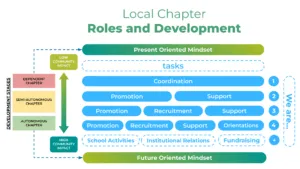
Local Chapter Roles and Development (1)

Supporting Chapters to Expand Their Vision and Increase Their Impact

Our goal at the organizational level is to support local chapters as they grow and evolve, progressing through different stages of development and increasing their impact in the community.
The more volunteers a chapter can engage, the more activities and tasks it can carry out. At the same time, fostering the growth and autonomy of these groups leads to greater community impact. This expanded capacity allows us to reach more beneficiaries and broaden the range of activities we offer: ultimately helping to fulfill the AFS mission of developing active global citizens.